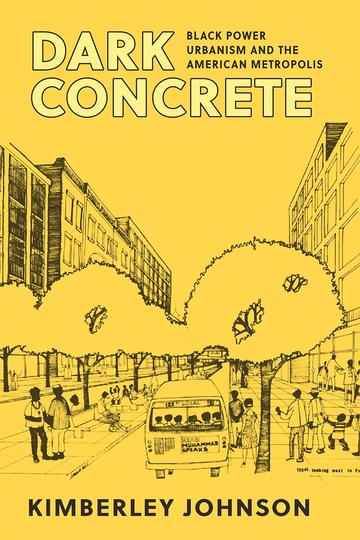


Dark Concrete: Black Power Urbanism and the American Metropolis
Dark Concrete is about how the Black Power movement reshaped urban politics in the United States—from expectations to practices. Although the national and international dimensions of the Black Power movement are often focused on, Kimberley Johnson looks at the movement at the local level, highlighting Newark and East Orange, New Jersey, and Oakland and East Palo Alto, California, and three policy areas: housing, education, and policing. She examines how Black Power Urbanism had its own local meanings as it was defined by local activists, neighborhood residents, parents, tenants, and others who sought to repair cities and particularly black neighborhoods that were shattered due to urban renewal and highway construction, as well as ongoing political and economic disinvestment. Dark Concrete depicts how local conditions influenced the emergence of the Black Power movement and, in turn, the ways in which these local movements reshaped urban politics, institutions, and place.
Kimberley S. Johnson is Professor of Social and Cultural Analysis at New York University, with affiliate appointments in the Department of Politics and the Wagner Graduate School of Public Service. She is also the author of Reforming Jim Crow: Southern Politics and State in the Age before Brown (Oxford University Press, 2010) and Governing the American State: Congress and the New Federalism, 1877–1929 (Princeton University Press, 2007). Her articles and essays have appeared in venues including Urban History, Studies in American Political Development, Urban Affairs Review, Du Bois Review, The Washington Post’s Monkey Cage, among others.