

Gender, Population, and the Early Formation of Atlantic Slavery
Diana Paton will deliver the 2026 Sir John Elliott Lecture in Atlantic History.
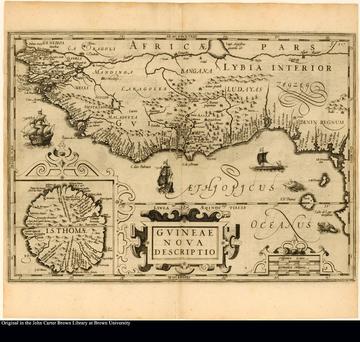
Recent important work on gender and slavery, including by Jennifer Morgan, Melanie Newton and Camillia Cowling, has focused on the significance of the matrilineal inheritability of slavery as the foundation of Atlantic slave societies. This lecture revisits these debates, attending particularly to the example of São Tomé in the eastern Atlantic. Colonised by the Portuguese from 1470, São Tomé was the first location in which Europeans developed sugar plantation agriculture that depended fully on the enslavement of Africans. In this early colony, the matrilineal inheritance principle was repeatedly disrupted in practice in order to secure the survival and reproduction of the slave-owning population. The island’s rulers and the Portuguese state relied not only on the reproductive labour of African women to produce its enslaved workers, but also on the reproductive labour of Jewish women and the sexual exploitation of enslaved African women to produce its ruling group. The modification of the matrilineal principle in this early Atlantic slave society has significant implications for understanding the later establishment and flexibility of the principle in other parts of the Atlantic world, and thus of the significance of gendered power within racial slavery.
Diana Paton is the William Robertson Professor of History at the University of Edinburgh. She is a historian of the the Greater Caribbean region, and its relationships with other parts of the world, and the author of No Bond but the Law: Punishment, Race, and Gender in Jamaican State Formation, 1780-1870 (2004), and The Cultural Politics of Obeah: Religion, Colonialism and Modernity in the Caribbean World (2015). She is currently working on a project examining the politics of maternity and reproduction in Atlantic slave societies.